
On Documenting The Return of Syrians.
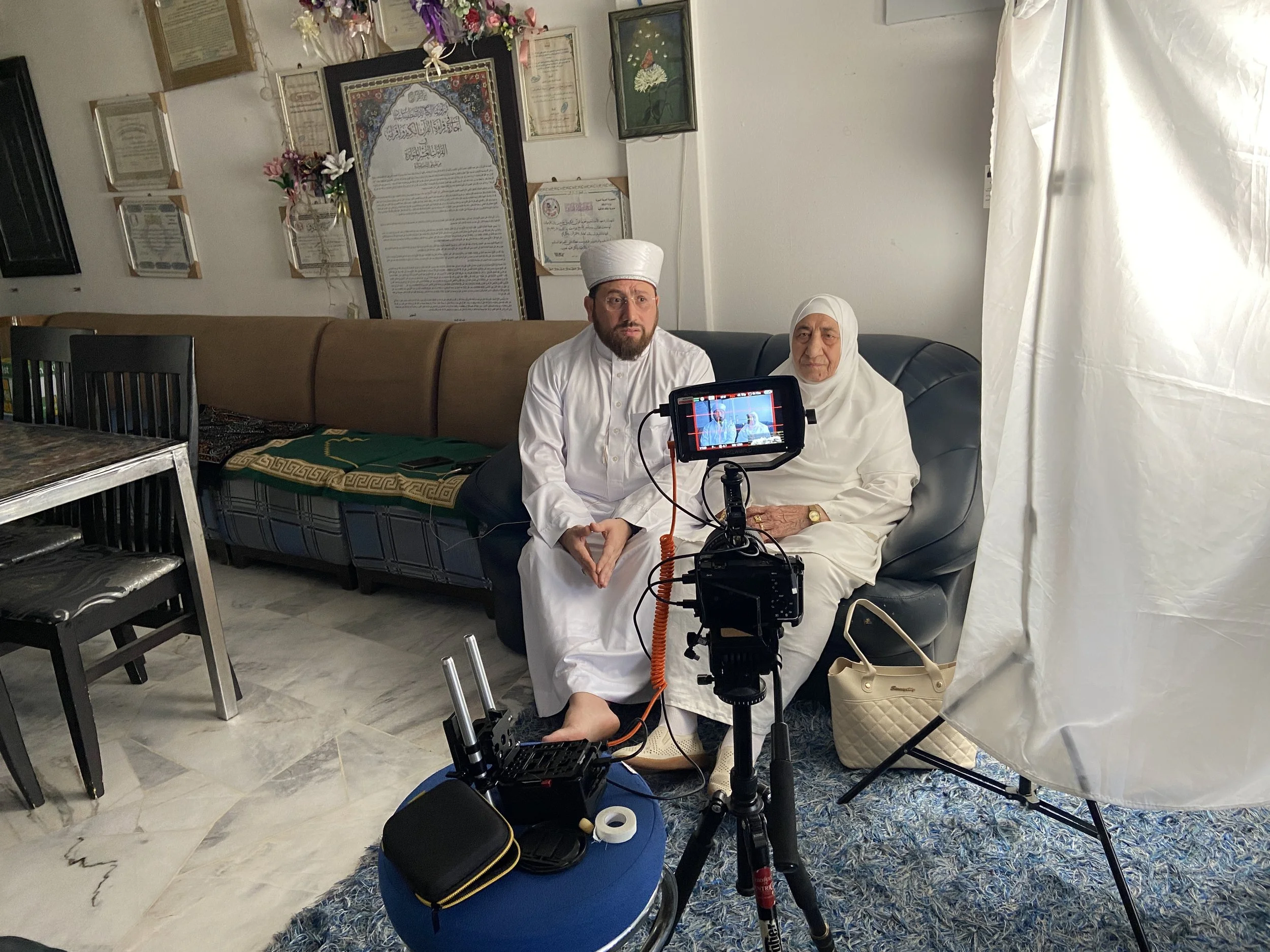
Mustafa Yousef fled Syria in 2013 on a fruit truck to Türkiye. After arriving in Malaysia for a Ramadan programme, he remained and was later granted temporary stay under Malaysia’s Syrian Migrant Temporary Relocation Programme (PPSMS). Today, he teaches at his Qur’an centre.
“ we are witnessing a rare moment in the history of a hard-earned freedom won by its people, where the act of RETURN itself, whether for a visit or for good, has become a symbol of victory “
The night the liberation happened, I was in a state of shock. Time seemed to pause. I took a break from everything I was doing just to follow the news.
A week earlier, when Aleppo was taken, I had already learned that Syrians in Malaysia were on high alert, closely watching every development. Events were unfolding so rapidly that, one of them told me, “we couldn’t sleep for three days because we had faith, this was finally the moment.” Then came the words:
“DAMASCUS HAS FALLEN”.
Homes were filled with prayers, tears, and cries of joy.
Mustafa Yousef Al-Sheikh, who fled Syria in 2013 and is now registered under Malaysia’s Syrian Migrant Temporary Relocation Programme, recalled that moment vividly.
The vibrant street of Bukit Bintang that never sleeps, came alive in a different way. Cars filled the night with honks, music, and celebration, waving the new green flag of Syria.
Within the community, there were emergency meetings, closed discussions, and private celebrations. I wished I could have been there, but at the time I had lost contact with many of my Syrian friends, in case I would attend any of the celebrations in Penang.
Instead, I spent that week visiting shawarma shops, congratulating those I met, and eventually made new friends. They were noticeably different from the Syrians I had known before. The Syrians I once knew were cautious and secretive, careful in words, avoidant of any extended conversation about their country's condition, and even had fear and trust issues among themselves
But now, they felt transformed, like people of a newly reborn nation. Every words they expressed are what they've kept aching deeply for a long time, as if they already knew that this day would certainly come.
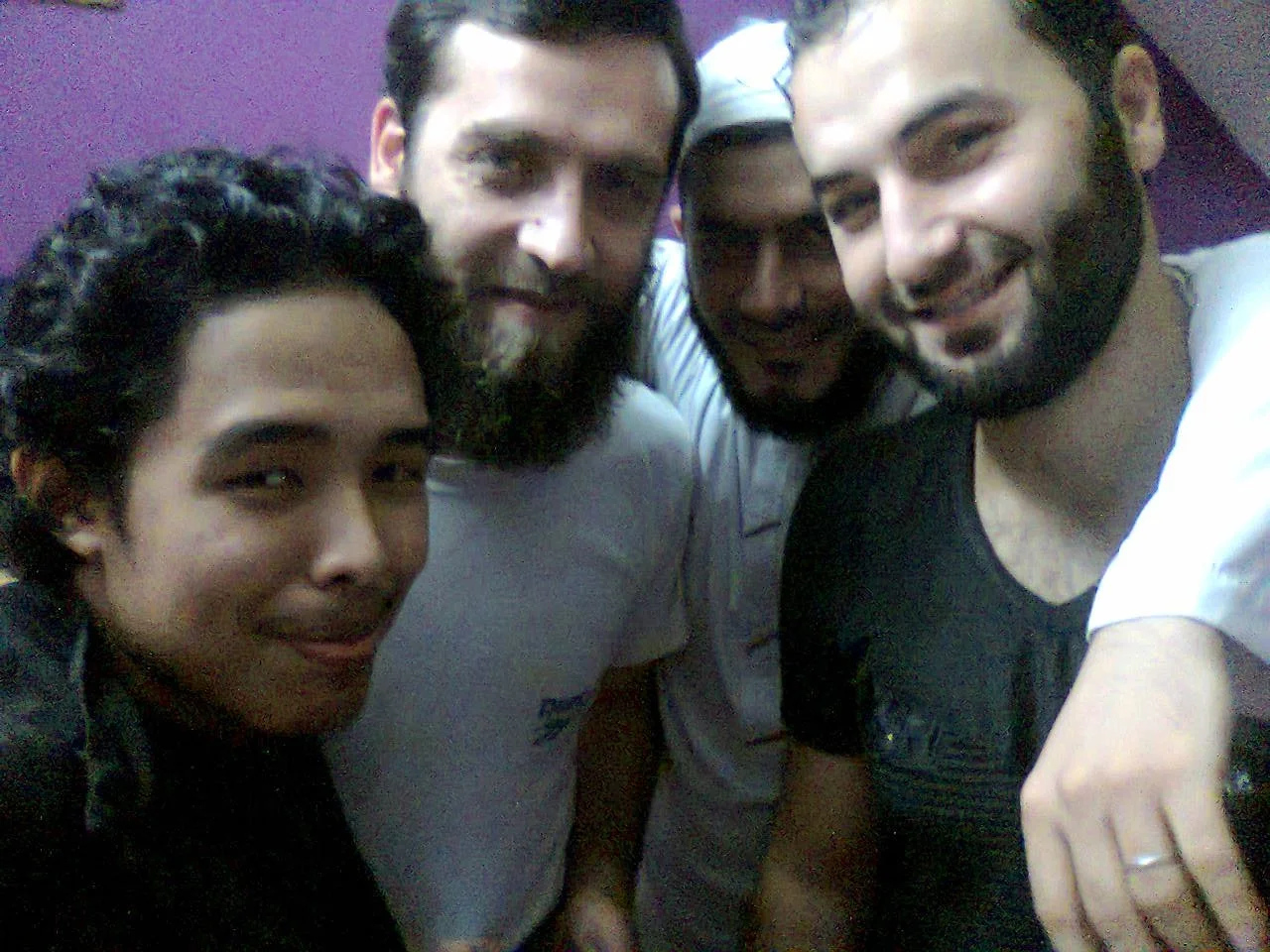
Accompanied a group of Syrian teachers from Aleppo, Syria to spent a month in Malaysia for a special Ramadan programme series in 2014.
Abo Ahmad (on the right end), the singer, was killed a month later during clashes with the Assad regime.
My connection with Syria began in 2013, at the height of global solidarity movements following the Arab Spring. I volunteered in media work with MAPIM, a Malaysian NGO dedicated to providing relief across Malaysia and internationally, working directly under the Director of Strategy, creating content videos for awareness campaigns and advocacy with raw materials from their humanitarian trips to the then war-torn Syria, Jordan and Egypt.
Although i was not qualified to join the on-the-ground mission, I found another way by building relationships with Syrian migrants in Malaysia, especially in Penang. Conversations that began casually, about business and daily life, gradually opened into deeper discussions about their homeland.
This was where the documentary first took shape, under its early working title “Syria – The Longest Revolution.”
In August 2014, I interviewed Muaz Abo Saleh, a Syrian teacher and activist who had lived through the early uprising in Aleppo. He had witnessed destruction firsthand, managed internal conflicts, and assisted humanitarian efforts. He came to Malaysia for a Ramadan program organised by MAPIM.
Alongside him were Abo Nasir Al-Attar, who would later establish a college in Gaziantep, and Abo Ahmad, a Syrian singer who was later killed in Aleppo during clashes with AlAssad regime forces.
Over time, Syrians became increasingly integrated into societies around the world. In Malaysia, being married to locals as such common case with some of my friends in Malaysia. Middle Eastern food culture were already becoming part of the urban food culture and Malaysian common choice, rather than exclusive before 2010s, thanks to the Syrians.
Yet challenges remained, particularly access to banking, education, and employment, largely due to uncertain legal status, for those who left the country due to the impact of the crisis.
Enforcement raids on Middle Eastern food outlets, where many Syrians worked, suspecting potential overstayers and those working without permits. As a result, many chose to remain within close-knit communities.
By 2017, I began losing contact with many of them. Some changed numbers, some stopped responding, and others possibly returned to Syria with no further news.
Eventually, I shifted my focus back to local activism.
For years, Syria ‘faded’ from global attention. Analysts often described the uprising as a tragedy without clear resolution. Many Syrians I met began to accept life abroad, becoming what they called “citizens of the world”, joining the room like 7 million Palestinians abroad (given as of 2018, Syrians fleeing the country rose up to 5.5 million).
Thirteen years later, while working at my desk, I casually opened Instagram. The first post I saw was breaking news from Al Jazeera:
“Syrian opposition says al-Assad fled, Damascus is ‘free’.”
Almost immediately, ‘returning’ became one of the key conversations among Syrians in Malaysia. Within a month, as Syria international air was open in January 7, videos of Syrians arriving at Damascus airport for the first time, welcomed by their families after many years, were feeding the news across social media.
That was when the title came to my mind:
“Syria – The Great Return”.
it came from the idea of : we are witnessing a rare moment in the history of a hard-earned freedom won by its people, where the act of RETURN itself, whether for a visit or for good, has become a symbol of victory.
This film documents the personal journey of their return to Syria after many years of living abroad.
In any films, this would be like jumping straight to act 3 and the ‘resolution’, no objective conflict or specific antagonistic force against the character except their own struggle to make the journey happen.
While post-liberation involves reconstruction, institutional reform, economic recovery, and diplomatic realignment, this film focuses on the aftermath, the adjustment, and the meaning of home.
As a Malaysian made, this film will remain with this part, a tribute to Syrians as an example and inspiration of a dignified diaspora. Stories of rebuilding, justice and accountability are best left to Syrians themselves to tell, in their own voices, for generations to come.
I began reaching out to Syrians in Malaysia through personal messages on Instagram, focusing on those preparing to return. Many declined for reasons of privacy and a desire to keep their journeys personal. (Fortunately, one individual instead offered to assist with the project).
At that point, I realised I needed a more professional approach. I reached out to organisations actively involved in humanitarian work for Syria and in managing the affairs of Syrian migrants in Malaysia, namely SyriaCare and MAHAR (Malaysian Humanitarian Aid and Relief).
SyriaCare was founded in 2013 by Malaysian alumni who had studied in Syria. Since then, it has been actively involved in humanitarian efforts across Jordan, Lebanon, Türkiye, and within Syria itself, particularly in the liberated Idlib after it came under opposition control in 2016.
What drew my attention was their Malaysian Village in Al-Bardaqli, a project that could potentially offer a rare opportunity to document Syrians rebuilding their lives inside the country and returning to homes once lost.
In 2017, the Malaysian government introduced a special programme for Syrian migrants, granting them temporary rights to live and work in the country. The programme has since been managed by MAHAR, in close coordination with the government. Today, MAHAR oversees approximately 1,200 Syrian migrants, many of whom fled Syria directly due to the conflict.
Engaging with these organisations gave me the advantage of searching for specific choices of individuals whose journeys truly reflect the full arc of displacement, survival, and return.
SyriaCare was the first to respond. While they clarified that their focus lies primarily in humanitarian aid to refugee camps rather than migrant affairs in Malaysia, they welcomed the project. During a meeting with Chairwoman Mrs Sakinah and her team, they expressed support and granted permission to film in their Malaysian Village in Syria when production reaches that stage.
They also shared plans for an upcoming winter campaign in October 2025, collecting clothing for Syrians facing harsh seasonal conditions. I offered to volunteer and document the effort, seeing it as a way to highlight in the film continued international solidarity.
Later that same day, I met with MAHAR. This meeting required a different level of preparation. MAHAR is, in many ways, the gateway to the core of this story. With over a thousand Syrians under thier care, the search for characters would be more specific and a subjects that are more affected by conflict rather than common migrant who have been here few years before the revolution.
I was received by the Programme Coordinator and the Migrant & Refugee Affairs Executive. I explained that this documentary is, at its heart, a tribute to the Syrian people and to a country like Malaysia that, despite not being a signatory to the 1951 Refugee Convention, has provided not just refuge, but a place to rebuild and prepare for the future.
They confirmed that Malaysia hosts the largest Syrian diaspora in Asia, a reflection of the country’s longstanding humanitarian commitment.
My specific request from them is to be introduced to individuals within their Syrian migrant community who might be willing to share their journeys as part of the film. I assured them that the process would fully respect privacy, sensitivity, and the long-term implications of representation, while remaining aligned with Malaysia’s legal and policy frameworks regarding migrants.
They understood the vision and asked for a formal proposal. Soon after, they expressed their willingness to cooperate when production begins.
As pre-production progressed, I realised that the first anniversary of the liberation was approaching, which was December 8 2024 to 2025. Two major events were being planned, one by the Syrian Embassy in Kuala Lumpur, and another by an organisation called the Syrian Community in Malaysia.
This will be my first reconnect with the Syrian community after many years.
At first, I considered approaching the embassy through NGO connections. But I decided otherwise to present myself directly. It felt more honest and respectful without presenting myself and the project as the NGO’s side commitment.
The embassy responded quickly, offering me an appointment.
I was received by Mr. Ibrahim, the chargé d'affaires. (an interim position instead of ambassador, given the current diplomatic context between Malaysia-Syria).
This embassy had been among the first in the world to raise the new Syrian flag and transition its administration within 24 hours of the fall of Bashar al-Assad.
The meeting was warm, open, and unexpectedly personal. We spoke about the condition of Syrians in the diaspora over the past 15 years, my connection with the community, and my intention to document the first liberation anniversary event.
More than anything, the meeting was a gesture of respect, to inform that this film is about the people under their governance abroad and that i, from Centriczone Films, will try to present and portray the free Syrian people as honourably as we can.
They welcomed the initiative and expressed openness to support where appropriate. As a token of appreciation, I was presented with the badge of the new Syrian emblem.
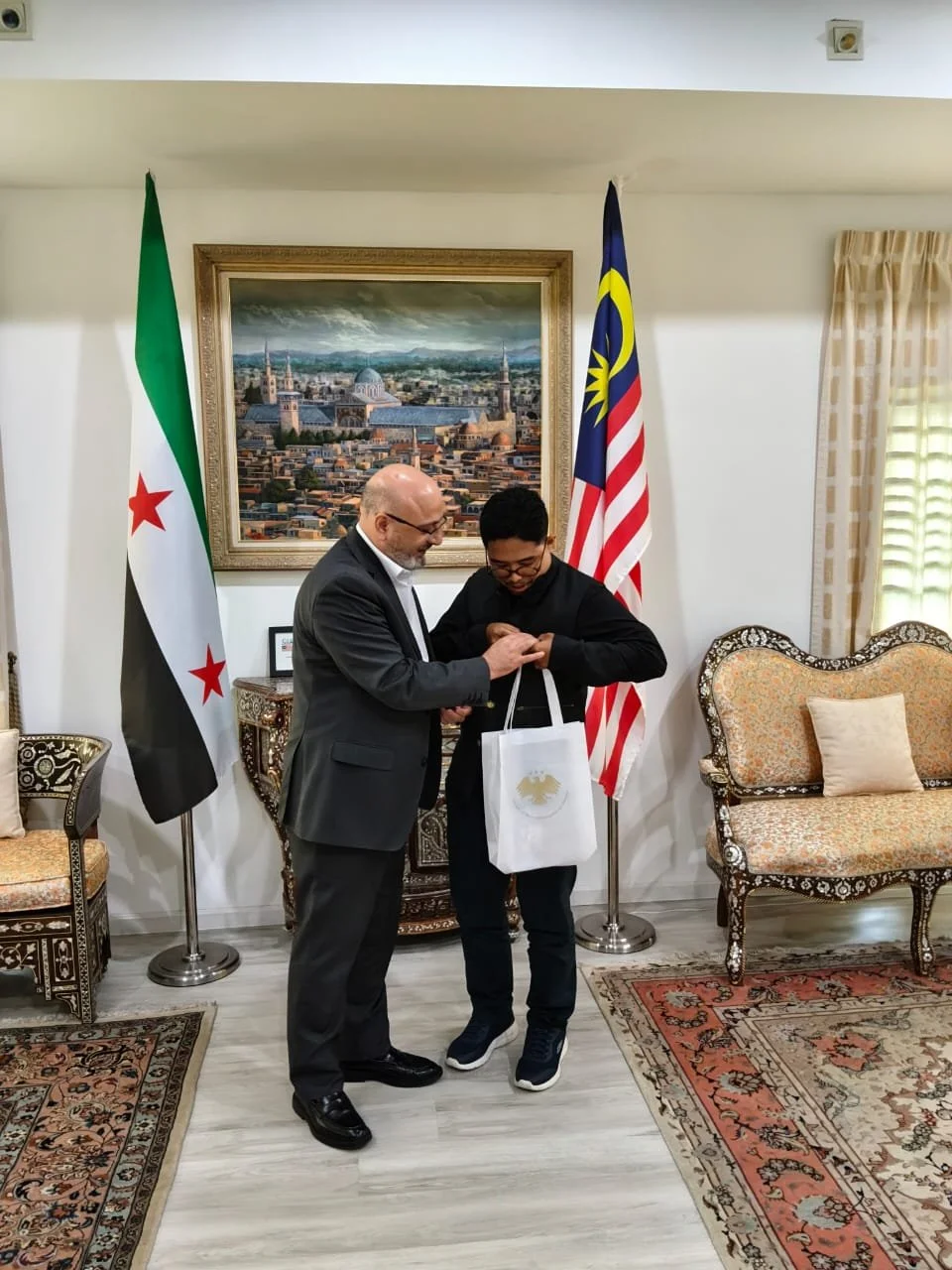
Mr. Ghiath Ibrahim, chargé d'affaires of the Syrian Embassy
of Kuala Lumpur presented me the badge of the new Syrian emblem.
7 December 2025, i witnessed something, Syrians has never been this easier before.
This place was once where Syrians never truly felt safe to approach, especially for those who had fled the war or had spoken out against the government. Even while living abroad.
Now, that was over. The people I once knew have now changed. They spoke freely, and finally embracing a sense of relief they had longed for over 50 years.
Very few Malaysians attended, despite invitations extended personally by Mr. Ibrahim. It would have meant a special thanks to Malaysia, which gave them a place to gain strength. I don’t remember how many times I was embraced, how many hands I kissed and were kissed in return. Words of gratitude were spoken in Arabic, as if I represented the Malaysian government myself.
By coincidence, the event fell on my birthday, 8 December. From that day on, This is how I will celebrate.
The following day, I attended a second celebration organised by the Syrian Community in Malaysia. This gathering was larger, bringing together migrants, business owners, Malaysian NGOs, and representatives from Syria’s Ministry of Foreign Affairs.
The night was glorious, with message videos from Syrian public figures, artists, activists, journalists, and officials screened from the stage.
It truly was a defining moment for them. From that day on, Syrians in Malaysia made progress. More programs on empowerment, business networking and training, with cooperative monitoring by the Syrian Department of Expatriates Affairs.
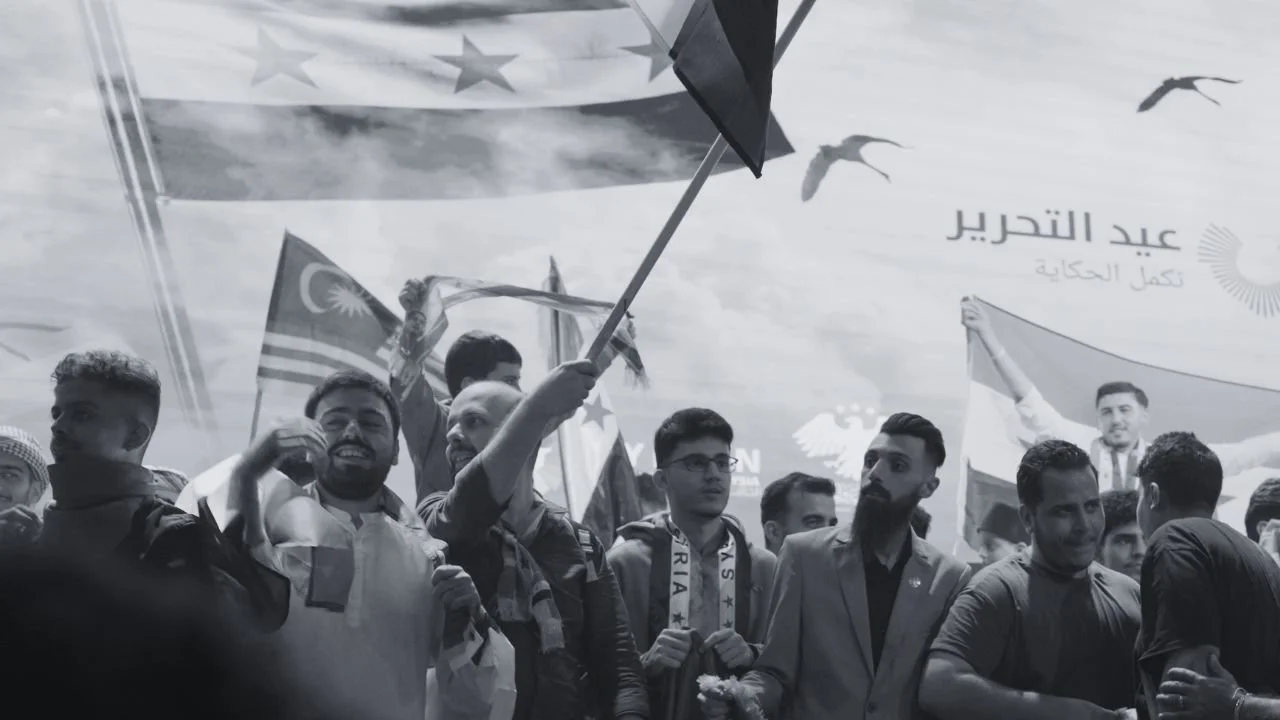
“Liberation day, the story lives forever”
I still never had enough congratulating every Syrians i met. Some of them may have moved on from the euphoria as a way, 'it's time to progress further', but there's this feeling left of me, for not doing enough the past 13 years. This film is made only to complete the 'unfinished business' of the Syrian cause.
Mustafa Yousef said "I will return to Syria soon, but maybe not permanently, rather visiting. I have established an educational centre here in Shah Alam and it has become a dream fulfilled, and responsibility I would never leave for the time being."
For now, I choose not to go to Syria. Because the Syria I know is more than a place, it is a lesson. That struggle begins from what is closest to you, and that belief perseveres even when everything ahead seems hopeless.
I do not want to see Syria just like any other country I've merely visited. I will one day visit with one of the people involved in the film.
With this film, we hope the global audience, starting with Malaysia, will learn and understand how one of the best diaspora communities in the world survived one of the most challenging humanitarian conflicts of our time.
Their presence everywhere has shown competency and cultural intelligence in the diaspora. It was an honour for Malaysia to have a community, one of the biggest in Asia, as a model and example of steadfastness like no other, endured 60 years of oppression, following the last 14 years of destruction and displacement, then gained victory, as Omar AlShoghre said “Syrians fought alone, dreamed alone”, without any foreign ‘humanitarian’ intervention, and all by themselves.
Shade Asri,
December 2025
